
Hip pain can make it harder to stay active, exercise and walk comfortably, or even complete your normal routine. In some cases, hip pain may be caused by femoroacetabular impingement, also known as FAI or hip impingement.
FAI occurs when the bones of the hip joint do not fit together as smoothly as they should. This can cause the bones of the hip to rub or pinch during movement, leading to hip pain, stiffness, and limited range of motion.
At Lakeshore Bone & Joint Institute, our hip joint specialists care for hip pain, FAI, labral tears, arthritis and other conditions affecting the hip. The team’s goal is to identify the source of your symptoms and help you understand the most appropriate treatment options, from conservative care to advanced surgical solutions when needed.
What is Femoroacetabular Impingement?
Femoroacetabular Impingement affects the hip joint. The hip is a ball-and-socket joint made up of the ball at the top of the thigh bone, called the femoral head, and the socket called the acetabulum, which is part of the pelvis.
FAI occurs when extra bone or an irregular shape in this joint between the acetabulum and femoral head causes the ball and socket to rub against each other. Over time, this friction can irritate the joint and may cause damage to the labrum, or the ring of cartilage that supports and stabilizes the hip.
FAI can affect athletes, active adults, and people who notice hip pain during certain movements. Some patients may have FAI for years before symptoms become more noticeable.
Types of FAI
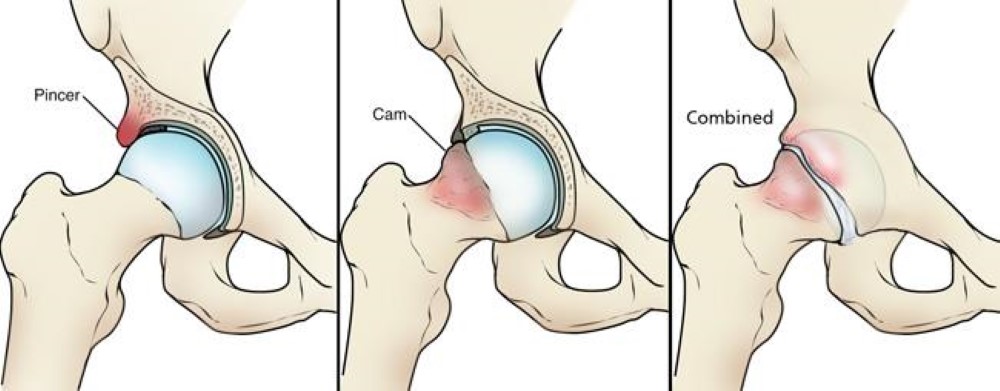
There are three main types of femoroacetabular impingement. Understanding the type of impingement helps orthopedic specialists determine which treatments may be most helpful.
- Cam Impingement occurs when the femoral head is not perfectly round. This can call the ball of the hip joint to rub against the socket during movement.
- Pincer Impingement occurs when the socket covers too much of the femoral head. This can pinch the labrum and surrounding tissues, causing pain.
- Combined impingement occurs when both cam and pincer features are present. This is the most common pattern for many patients with FAI.
FAI is typically diagnosed through a physical exam, a review of your symptoms, and imaging. Your specialist will ask when your hip pain started, if there are movements that make it worse, and how symptoms affect your daily life.
Imaging, including X-rays, will help your hip specialist look at the shape of the hip joint and any signs of arthritis. In some cases, an MRI may be recommended to evaluate the labrum, cartilage, or soft tissues surrounding the hip.
Diagnosis focuses on understanding whether the symptoms you are experiencing are caused by FAI, another hip condition, or a combination of issues. From there, your hip specialist will help put together a treatment plan designed to get you back to feeling your best.
Symptoms of FAI
FAI symptoms can vary, but many patients feel pain in the front of the hip or groin. Pain may be worse when sitting, squatting, running, pivoting, climbing stairs, or getting in and out of a car.
Other common symptoms can include stiffness in the hip, limited range of motion, clicking or catching, discomfort after exercising, or pain that travels into the thigh or buttock.
Hip pain can come from several conditions, including arthritis, bursitis, muscle strain, tendon irritation, or a labral tear, so an evaluation with a hip specialist is crucial to understanding the cause of your hip pain symptoms.
FAI and Hip Arthritis
FAI may increase stress inside the hip joint over time. In some patients, this can contribute to other conditions including labral tears, cartilage damage, and arthritis.
This does not mean that every patient with FAI will need surgery or an eventual hip replacement. Many patients improve with conservative treatment, especially when symptoms are addressed early. If joint damage becomes more advanced, an orthopedic specialist will be able to discuss additional treatment options, including whether hip replacement may be appropriate.
Treatment of FAI
Treatment for FAI depends on your symptoms, activity level, imaging, and whether there is damage to the labrum or cartilage.
Many patients start with conservative care. This may include physical therapy, activity modification, anti-inflammatory medication, and injections to reduce pain and inflammation.
Physical therapy for FAI focuses on improving hip strength, flexibility, movement patterns, and joint stability. Activity changes may also help reduce movements that cause pinching or irritation in the hip.
If conservative care does not provide relief, surgical options may be discussed. Some patients may be candidates for a hip arthroscopy, which is a minimally invasive procedure that can treat certain causes of hip impingement or labral damage. In more advanced cases involving arthritis or joint damage, hip replacement may be discussed. At LBJI, our hip specialists help patients understand their options and choose the treatment plan that best fits their condition, lifestyle, and goals.
Frequently Asked Questions (FAQ)
When should I see a specialist for hip pain?
If hip or groin pain is persistent, worsening, or limiting your normal activities, schedule an appointment with a hip specialist.
Is FAI the same as a hip labral tear?
No. FAI and a labral tear are different, but they can be related. FAI can place extra stress on the hip joint and may contribute to labral tears over time.
Can FAI be treated without surgery?
Yes. Many patients start with nonsurgical care such as physical therapy, activity modification, anti-inflammatory medication, or injections. If symptoms do not improve, your specialist may discuss surgical options.
Does FAI always lead to hip replacement?
No. FAI does not always lead to hip replacement. Treatment depends on your symptoms, imaging, and the amount of joint damage. Hip replacement is usually considered when arthritis or joint damage is more advanced.
Find the Right Treatment for Hip Pain
Hip pain can keep you from moving comfortably, but you do not have to guess what is causing it. If symptoms are interfering with your daily life, an orthopedic evaluation can help determine whether FAI, arthritis, a labral tear, or another hip condition may be involved.
At Lakeshore Bone & Joint Institute, our hip and joint specialists provide personalized care to help patients reduce pain, restore movement, and return to the activities they enjoy.
Schedule an appointment to learn which hip treatment options may be right for you.